Table of Contents
ToggleIntroduction
Data centers power today’s digital economy, supporting everything from cloud services and banking systems to healthcare, telecommunications, and artificial intelligence. As these facilities become more advanced, so do the fire risks associated with their operation.
Unlike conventional commercial buildings, data centers house densely packed electrical equipment that operates continuously. Even a minor incident can lead to equipment damage, service interruptions, and significant financial losses.
Understanding the most common fire hazards is the first step in designing an effective fire protection strategy. When combined with early detection systems, SUPREME-X Inert Gas fire suppression provides a reliable solution for protecting critical infrastructure while minimizing operational disruption.
Why Fire Protection is Critical in Data Centers
A fire in a data center is more than just a safety concern—it can disrupt business operations, damage valuable equipment, compromise sensitive data, and impact customers who rely on uninterrupted services.
Modern data centers are expected to maintain continuous availability. Even a few minutes of downtime can result in financial losses, reputational damage, and contractual penalties.
This is why fire protection systems must not only extinguish fires quickly but also preserve critical assets and support business continuity.
Common Fire Risks in Data Centers
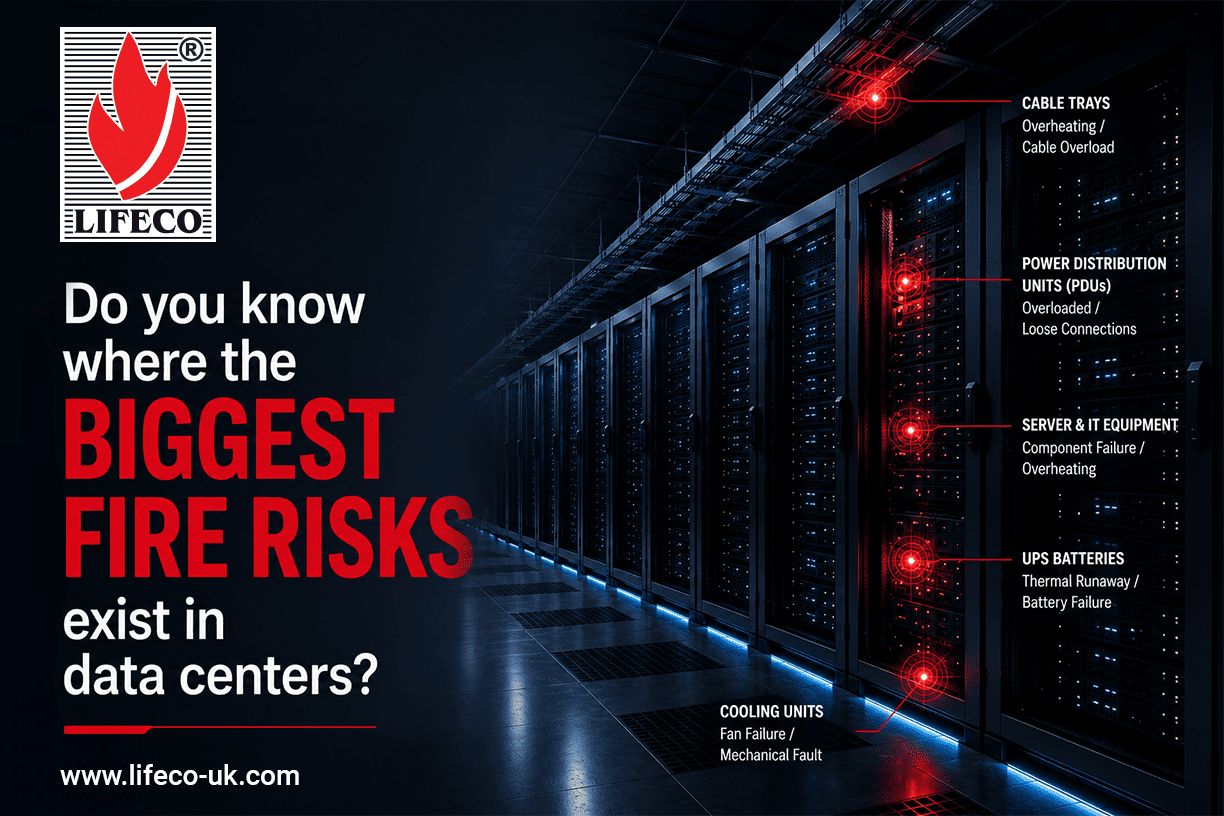
1. Electrical Equipment Failures
Electrical faults remain one of the leading causes of fires in data centers. Overloaded circuits, faulty wiring, damaged insulation, and equipment failures can generate excessive heat, eventually leading to ignition.
Areas commonly affected include:
- Server racks
- Power Distribution Units (PDUs)
- Switchgear
- Transformers
- Electrical panels
Because these systems operate continuously, even small faults can escalate rapidly if not detected early.
2. UPS Systems
Uninterruptible Power Supply (UPS) systems ensure continuous power during outages, but they also introduce fire risks due to high electrical loads and heat generation.
Potential hazards include:
- Internal component failures
- Overheating
- Electrical arcing
- Capacitor failures
Protecting UPS rooms is a critical part of any data center fire protection strategy.
3. Battery Energy Storage Systems (BESS)
Many modern data centers rely on battery banks to support emergency power systems.
Whether using lead-acid or lithium-ion batteries, battery rooms present unique fire hazards, including:
- Thermal runaway
- Electrical short circuits
- Overcharging
- Mechanical damage
These risks require specialized fire detection and suppression solutions to prevent fire from spreading to adjacent equipment.
4. Overheated Server Equipment
High-performance servers generate substantial heat during operation. Although cooling systems are designed to maintain safe temperatures, failures in cooling infrastructure or blocked airflow can cause components to overheat.
Potential causes include:
- Cooling system failure
- Blocked air circulation
- Dust accumulation
- Fan malfunction
Continuous environmental monitoring helps identify these issues before they become serious fire hazards.
5. Cable Trays and Raised Floors
Power and communication cables often run beneath raised floors or above ceilings. These concealed spaces can contain combustible cable insulation, making them vulnerable to fire spread.
Without early detection, a fire can travel through cable pathways before becoming visible, increasing the potential for extensive damage.
How Inert Gas Systems Mitigate These Risks
An inert gas fire suppression system is designed to extinguish fires at an early stage by reducing the oxygen concentration within the protected enclosure to a level where combustion cannot continue while maintaining conditions that allow occupants to evacuate safely.
Unlike water or foam systems, inert gas:
- Leaves no residue
- Does not damage electronic equipment
- Is non-conductive
- Reaches enclosed spaces effectively
- Allows faster recovery after a fire incident
This makes it especially suitable for protecting mission-critical environments.
The Importance of Early Detection
Fire suppression is most effective when paired with advanced detection systems.
Modern data centers often use:
- Aspirating Smoke Detection (ASD)
- Addressable fire alarm systems
- Cross-zone detection
- Automatic suppression system activation
These technologies can detect smoke particles long before visible flames appear, allowing inert gas systems to activate during the incipient stage of a fire.
Protecting Business Continuity
The primary objective of data center fire protection is not simply to extinguish a fire—it is to maintain uninterrupted operations.
An effective fire protection system helps organizations:
- Protect valuable IT assets
- Reduce downtime
- Minimize repair costs
- Preserve critical business operations
- Meet customer service commitments
For operators of mission-critical facilities, these benefits are just as important as life safety.
LIFECO’s Inert Gas Fire Suppression Solutions
LIFECO provides complete inert gas fire suppression solutions for data centers, server rooms, UPS rooms, battery rooms, telecommunications facilities, and other mission-critical environments.
From system design and engineering to installation, testing, commissioning, and maintenance, LIFECO delivers solutions that comply with international fire protection standards while helping organizations safeguard their most valuable assets.
Conclusion
Data centers face a wide range of fire risks, from electrical failures and battery systems to overheating equipment and concealed cable pathways. Because these facilities depend on continuous operation, fire protection must go beyond simply extinguishing flames.
Inert gas fire suppression systems provide fast, clean, and reliable protection without damaging sensitive equipment, making them one of the most effective solutions for modern data centers.
By combining early fire detection with properly designed inert gas suppression systems, organizations can protect critical infrastructure, reduce downtime, and ensure long-term business continuity.
Ready to Protect Your Data Center?
Choosing the right fire suppression system is essential for protecting valuable assets, maintaining business continuity, and meeting international fire safety standards.
Whether you’re planning a new data center, expanding your existing facility, or upgrading your fire protection system, LIFECO’s engineering specialists are ready to help.
Get in touch with LIFECO today to discuss your project requirements, request a consultation, or discover how Supreme-X Inert Gas Fire Suppression can protect your mission-critical environment.
 Back
Back